Hip flexor stretches for the front of your hips
Sitting keeps the front of your hips folded for hours, and standing up straight can feel like unfolding a hinge. These routines move through half-kneeling, seated and deeper hip shapes at a pace you set, one side at a time.
Start with a free 5-minute stretchFree first, no account needed. Then Floor Hip Flow (10 min, guided by voice) and every routine with a 7-day free trial: card required, nothing charged before day 8.
Good for
- Standing up straight after a long stretch of sitting
- Walking stiffly for the first few steps
- Long drives and flights
- Anyone who wants a hip routine that fits the floor or a chair
Why a few slow minutes can help
The muscles across the front of your hips shorten a little when you stay seated, and they often feel tight when you stand and take a long step. A slow lunge-style stretch lengthens them a bit in the opposite direction.
Starting on the floor and finishing with a chair option means you can pick the version your knees like. Holds are timed and both sides get the same time.
Floor Hip Flow
A slow sequence for your mat.
- 10 minutes
- 7 movements
- No equipment
- Floor
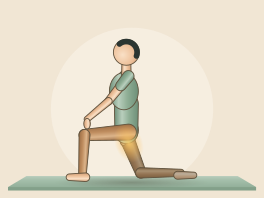
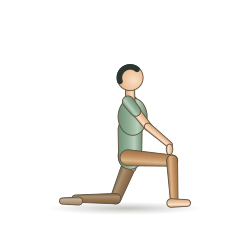
Half-kneeling hip release
Keep your ribs above your pelvis. Gently tuck your tailbone.
Easier: Take a smaller movement. Skip kneeling if it is uncomfortable for your knees.
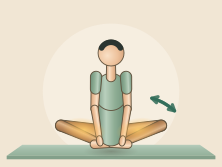
Butterfly sit
Hold your ankles lightly and let your knees rest open under their own weight.
Easier: Move your feet farther away. Skip if the position pinches your hips or knees.
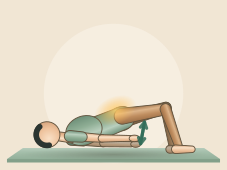
Glute bridge
Press through your feet and lift your hips a little way off the floor.
Easier: Lift your hips only an inch or two, or practice pelvic tilts instead.
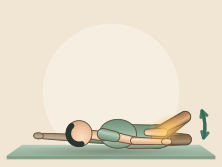
Side-lying clamshell
Keep your feet together and slowly lift your left knee, like a clamshell opening.
Easier: Open the knee only a little, and rest more often.
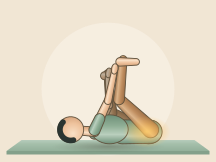
Happy baby
Hold the outside edges of your feet or your shins, soles of your feet toward the ceiling.
Easier: Hold behind your thighs instead of your feet if reaching them is uncomfortable. Skip if lying on your back is uncomfortable.
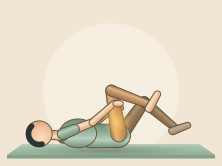
Reclined figure-four
Cross your left ankle over your right knee and let the left knee open out.
Easier: Keep your right foot on the floor and let the crossed knee rest open.
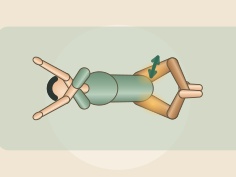
Lying butterfly
Rest your hands on your belly or out to the sides.
Easier: Keep your feet flat and knees bent, or rest your knees on pillows.
Tips for a comfortable session
- Squeeze the glute of the back leg lightly and tuck your tailbone before you lean forward.
- Pad your knee with a folded towel or a cushion.
- Pick the chair routine on days when kneeling is not comfortable.
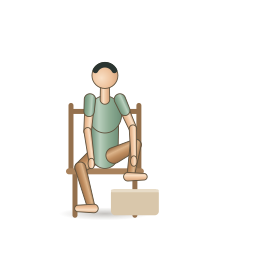
Chair Hip Rotation
Foot up, lean in: open your hips from a chair or the edge of your bed.
- 5 minutes
- 4 movements
- Chair
- Chair
- Chair hip rotation45 s each side
- Seated figure-four45 s each side
- Seated hamstring stretch30 s each side
- Seated ankle circles30 s each side
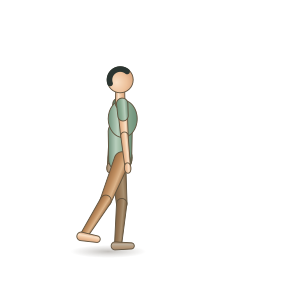
Deeper Hip Opener
For when gentle feels easy: longer lines through the hips.
- 15 minutes
- 10 movements
- Wall
- Wall, Standing, Floor
- Standing leg swings1 min each side
- Standing hip circles1 min
- Low lunge with reach1 min each side
- Half-kneeling hip release1 min each side
- Reclined figure-four1 min each side
- Lying knee-across twist1 min each side
- Butterfly sit1 min
- Side-lying clamshell45 s each side
- Happy baby45 s
- Glute bridge45 s
Common questions
How long is the Floor Hip Flow routine?
10 minutes and 7 timed movements. Left and right sides get equal time, and a voice guides every change.
Do I need a mat or any equipment?
No equipment. Setups used: floor.
What does ReliefFlow cost?
Every plan starts with a 7-day free trial. A card is required to start it, and you pay nothing if you cancel before day 8. After that it is $5.99 a month or $49.99 a year, and you can cancel any time from Manage billing.
Is it safe if something already hurts?
ReliefFlow is general wellness guidance, not medical advice. Skip the half-kneeling movement if it bothers your knees, and check with your surgeon or clinician about deep hip movements after a hip replacement. Stop if anything hurts, and talk to a health professional about pain that is sharp, radiating, new or does not ease.